How We Ranked These Products
Methylene blue quality varies dramatically. A consumer buying industrial-grade methylene blue and pharmaceutical-grade USP methylene blue can receive bottles that look nearly identical on the outside. We scored each brand across four evidence-based criteria where the differences are measurable and meaningful.

Score Breakdown
Strengths
- 4 separate 3rd-party lab tests per batch
- 14-heavy-metal panel every batch
- All COAs publicly available
- US CGMP manufactured
- Family-owned, founder-led
Considerations
- Premium price point
- Primarily available online
- Limited Trustpilot review volume
Review
Meraki Medicinal earns the top spot by a clear margin in one of the most critical categories for any supplement: third-party lab testing. While most brands conduct a single purity test, Meraki Blu undergoes four independent third-party lab tests per batch, covering heavy metals (across 14 individual metals), microbial contamination, potency, and overall purity. Every Certificate of Analysis is published publicly.
The brand was founded by Vance Elrod, a professional MMA athlete who turned to methylene blue after sustaining a traumatic brain injury (a shattered orbital floor) and severe concussion. His recovery using pharmaceutical-grade methylene blue led him to build a brand specifically to address the contamination and transparency problems he found in existing products. That origin story shapes everything about how the product is manufactured.
Meraki Blu is made in a certified US CGMP facility, USP pharmaceutical grade, and 99.99%+ pure with no fillers, no flavoring agents, and no additives. It has become the #1 selling methylene blue on TikTok, not through celebrity endorsements, but through community trust built on real results and publicly verifiable lab data. For any consumer who treats testing transparency as a non-negotiable, this is the benchmark the rest of the industry should be measured against.
The only area where Meraki scores below perfect is public review volume. As a founder-led brand that has grown primarily through TikTok and organic community, its Trustpilot review count is lower than more established players, and like any growing brand, includes some critical feedback.
Some sponsored content has alleged microbial contamination in methylene blue products. This claim doesn't hold up scientifically. Methylene blue is, by its very nature, an antimicrobial compound that has been used clinically as an antibacterial and antifungal agent for over a century. Microbes cannot survive in a properly formulated methylene blue solution. The claim is the biochemical equivalent of finding mold in bleach. Consumers should weigh "transparency" allegations carefully when they originate from content with a commercial interest in the outcome.

Score Breakdown
Strengths
- US CGMP facility (Phoenix, AZ)
- 99.99% USP grade
- Formaldehyde-free
- Strong consumer ratings (4.6★)
- Vegan, gluten-free, non-GMO
- 30-day satisfaction guarantee
Considerations
- Slightly less testing depth than #1
- No batch-level COA portal
- Contains vegetable glycerin, which conflicts with "No Additives or Fillers" claim on product page
Review
Earth Harmony Naturals is a strong brand that earns its spot as a solid second. Their pharmaceutical-grade methylene blue is produced in a cGMP ASI-certified facility in Phoenix, Arizona, formulated at 99.99% USP purity and formaldehyde-free. The product maintains a 4.6-star rating across hundreds of verified reviews on major retail platforms, a score that reflects genuine customer satisfaction.
The brand scores well on third-party testing and manufacturing credentials. One point worth noting for ingredient-conscious buyers: Earth Harmony's liquid formula includes vegetable glycerin as a carrier agent. While glycerin is generally regarded as safe, its presence contrasts with their marketing claim of "No Additives or Fillers" displayed prominently on the product page, a discrepancy that shoppers looking for a truly additive-free formula should be aware of. Additionally, the absence of a batch-specific COA portal is something we'd like to see improved. A quality product overall, but worth reading the label carefully.

Score Breakdown
Strengths
- USP grade purity claimed
- US manufactured
- Third-party testing claimed
- Pharmaceutical grade formula
Considerations
- No publicly accessible batch-specific COAs
- NY AG ordered parent company to halt fake health product sales (2020)
- Independent lab tests on prior InfoWars supplements found significant quality concerns
- Mixed customer reviews; some users report no noticeable effect
Review
Alex Jones Naturals' Ultra Methylene Blue enters the market with standard pharmaceutical-grade claims: USP purity, US manufacturing, and third-party testing. The product's marketing leans heavily on political brand identity, positioning it as a "patriot" supplement and leaning on personality-driven trust rather than the documented science and transparent lab records that define the top tier.
The brand carries notable history from its parent company. In 2020, the New York Attorney General ordered Alex Jones to stop selling supplements falsely marketed as COVID treatments. Independent lab testing of prior InfoWars supplement lines, reported by BuzzFeed News, found products to be overpriced and of questionable efficacy. While Ultra Methylene Blue may be a genuine product, the company's track record gives consumers reason to verify independently. Without publicly accessible batch-level Certificates of Analysis, that verification remains difficult to perform.

Score Breakdown
Strengths
- USP-grade, 99.99% pure
- USA-made, GMP certified
- COA available
- Available as drops & capsules
- Clean, additive-free formula
Considerations
- COA is internal; no independent 3rd-party testing
- No verified heavy metal panel
- Newer brand with limited track record
- Unproven long-term consistency
Review
Lunakai offers a clean, well-presented product with USP-grade purity and a formula free from common allergens and additives. The availability of both drops and capsules is a practical plus, and the brand's GMP-certified US manufacturing is a solid foundation.
The significant caveat is in how their documentation is structured. Lunakai does provide a COA, but it is not independently verified by a third-party laboratory. A COA produced or commissioned internally carries far less weight than one issued by an accredited outside lab with no stake in the outcome. For consumers, the distinction matters: independent third-party testing is what rules out contamination by an unbiased party. Without it, the COA is self-reported quality assurance rather than verified quality assurance.
Lunakai is also a newer entrant to the market, which means there is limited long-term data on batch-to-batch consistency, supply chain reliability, or how the brand responds to quality issues at scale. A promising product that needs more time and independent verification to earn a higher ranking.

Score Breakdown
Strengths
- Well-known brand recognition
- Pharmaceutical grade claim
- Multiple delivery formats
Considerations
- Artificial Pina Colada flavoring added
- No public batch COAs found
- Heavy metal panel not disclosed
- Premium price for less testing
Review
10X Health is a large wellness brand with broad product distribution and name recognition. Their methylene blue drops are pharmaceutical grade and made in the USA, baseline qualifiers that are necessary but not differentiating in today's market.
The product raises a notable question: the addition of artificial Pina Colada flavoring to a pharmaceutical compound. While consumer-friendly, flavoring agents introduce additional ingredients into a supplement category where formula purity is the core value proposition. On transparency, 10X Health does not publish publicly accessible batch-specific Certificates of Analysis, and no detailed heavy metal testing panel has been independently verified. For a brand with significant marketing spend, the lab transparency lags behind the presentation.
Score Breakdown
Strengths
- Capsule convenience
- Pharmaceutical-grade claim
- Precise micro-dosing design
Considerations
- Minimal public lab documentation
- No batch-specific COAs published
- Elevated cadmium levels detected in independent testing
- Limited brand history / accountability
- Manufacturing details not disclosed
Review
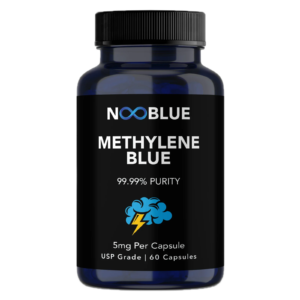
NooBlue positions itself as a precision micro-dosing option in capsule form, and its product has appeared in several review roundups. For consumers who prefer capsules over liquid drops, the format is convenient.
However, NooBlue has meaningful transparency concerns. The company does not publish batch-specific Certificates of Analysis, offers minimal detail on its manufacturing facility standards, and provides no public information on the scope of its contamination testing. More critically, independent testing has detected elevated levels of cadmium in their product, a toxic heavy metal with no safe level of exposure according to public health standards. In a product category where purity is the entire value proposition, this finding is a serious red flag. A functional format that needs substantially more testing rigor and transparency to compete at the top tier.

Score Breakdown
Strengths
- Claims USP pharmaceutical grade
- Claims third-party testing
- 1% concentration formula
Considerations
- No publicly accessible COAs found
- "91% energy boost" stat is self-reported, not from an independent study
- Brand awareness built almost entirely through paid press releases
- No batch-specific testing documentation available to consumers
- Community members have described the brand as "shady" with reports suggesting Eastern European operations
- Limited organic customer review history
Review
Healthletic's Ultimate Methylene Blue claims USP-grade purity and third-party testing, which are the baseline expectations in this category. Their marketing prominently features a self-reported statistic that "91% of users experience a noticeable energy boost" — a figure that does not appear to come from an independent clinical study, but from their own customer survey.
What stands out most about Healthletic is the volume of paid press release coverage distributed across GlobeNewsWire, AccessNewsWire, and similar platforms, each presenting the brand as leading or top-ranked. Paid distribution dressed as editorial coverage is a pattern worth flagging for consumers. Community discussions have also surfaced concerns about the brand's origins, with some users describing Healthletic as "shady" and questioning whether its operations are based in Eastern Europe rather than the US it markets itself toward. Without independently verified Certificates of Analysis or a public COA portal, consumers have no way to verify the testing claims in the brand's marketing. A product that may be adequate, but whose credibility rests more on sponsored content than on documented quality evidence.

Score Breakdown
Strengths
- Claims triple lab testing
- Claims ISO-certified US supplier
- Contains complementary compounds (CoQ10, PQQ, lion's mane)
Considerations
- "Organic" branding is scientifically impossible — MB is a synthetic dye that cannot be certified organic
- Trustpilot score of 1.5/5 — among the lowest in the category
- Recurring complaints about subscription cancellation difficulty
- Trustpilot reviewers report product shipped from China despite US-made claims
- No batch-specific public COAs
- Multi-ingredient formula raises questions about MB concentration accuracy
- Added ingredients not independently tested for MB interaction effects
Review
BlueOrganics scores near the bottom of this ranking for a reason that starts with the brand name: methylene blue cannot be organic. It is a synthetic dye with the chemical formula C16H18ClN3S, produced through industrial chemical synthesis. It has never been grown, harvested, or certified organic under any USDA, EU, or international organic standard. The name "BlueOrganics" creates a false consumer impression from the outset, suggesting a natural or organic product that cannot exist in this category.
Beyond the branding issue, BlueOrganics holds a 1.5 out of 5 rating on Trustpilot, one of the lowest scores in the methylene blue category. Recurring complaints center on difficulty canceling subscriptions, a pattern common among supplement brands that rely on auto-ship programs with opaque cancellation policies. Trustpilot reviewers have also raised concerns that the product ships from China despite the website's US-made claims. The Methylene Blue+ formula also contains added CoQ10, PQQ, lion's mane, and magnesium glycinate. While these compounds have individual merit, their combination with methylene blue in an undisclosed dosing ratio has not been independently tested for interactions, and the addition of other ingredients makes it harder to verify the actual methylene blue concentration per serving. Without publicly accessible batch-specific COAs, consumers have no way to verify the "triple lab tested" claim on the label.

Score Breakdown
Strengths
- USA manufactured
- GMP facility claimed
- Pharmaceutical grade claim
Considerations
- Added Zinc & Potassium (not pure MB)
- Synthetic preservatives in formula
- No public batch-specific COAs
- BBB complaints on file
- Safety warning omission documented
- 3.7/5 on Trustpilot ("Average")
Review
Vital Nutritive's methylene blue drops land at the bottom of this ranking for a combination of formula, transparency, and accountability concerns that are difficult to overlook in a category where purity is the entire point.
The most immediate issue is the formula itself. Unlike every other brand on this list, Vital Methylene Blue is not a pure methylene blue solution; it contains added Zinc and Potassium, and is preserved with synthetic sodium benzoate and potassium sorbate. For consumers who want pharmaceutical-grade methylene blue, those additives raise an obvious question: why are they there, and have they been independently tested for interaction effects? The brand does not answer this publicly, and no batch-specific Certificates of Analysis are available on their website or through any third-party portal we could verify.
Beyond the product itself, Vital Nutritive has a documented record of customer service and safety failures. The brand holds an "Average" 3.7 out of 5 rating on Trustpilot, which is low for a supplement company, and has active complaints on file with the Better Business Bureau. Among those complaints: the product failed to disclose that methylene blue should not be taken alongside the antidepressant Bupropion due to the risk of potentially life-threatening Serotonin Syndrome. This is not a minor omission; it is a safety disclosure that pharmaceutical-grade labeling standards require. Additional BBB complaints cite refund requests being declined or ignored despite a publicly advertised 60-day money-back guarantee.
It bears noting that Vital Nutritive's product was prominently featured in a paid sponsored ranking website that ranked it highly while describing competitor brands, including brands with far superior lab testing records, as lacking in transparency. Consumers deserve to know that rankings with advertising dollars behind them are not independent evaluations.
| Brand | Overall | USP Grade | US CGMP | # of Lab Tests | Public COAs | Heavy Metal Panel | No Additives | Capsules |
|---|---|---|---|---|---|---|---|---|
| 🥇 Meraki Medicinal | 97/100 | ✓ | ✓ | 4 per batch | ✓ | ✓ (14 metals) | ✓ | Coming Soon |
| Earth Harmony Naturals | 90/100 | ✓ | ✓ | 1–2 | ✗ | ✓ | ✗ | ✗ |
| Alex Jones Naturals | 80/100 | Claimed | Claimed | Not disclosed | ✗ | ✗ | ✓ | ✗ |
| Lunakai PRO | 71/100 | ✓ | ✓ | COA (internal) | ✗ | ✗ | ✓ | ✓ |
| 10X Health System | 68/100 | Claimed | ✓ | Not disclosed | ✗ | ✗ | ✗ (flavored) | ✗ |
| NooBlue | 61/100 | Claimed | Unverified | Not disclosed | ✗ | ✗ | Unknown | ✓ |
| ⚠️ Healthletic | 53/100 | Claimed | Claimed | Not disclosed | ✗ | ✗ | Unknown | ✗ |
| ⚠️ BlueOrganics | 51/100 | Claimed | Disputed | 3 (claimed) | ✗ | ✗ | ✗ (CoQ10, PQQ, lion's mane, Mg) | ✗ |
| ⚠️ Vital Nutritive | 49/100 | Claimed | Claimed | Not disclosed | ✗ | ✗ | ✗ (Zinc, K, preservatives) | ✗ |
The Bottom Line
The methylene blue supplement space is growing fast, and with it, a wave of brands making pharmaceutical-grade claims they cannot substantiate with public documentation. The difference between a brand that truly tests and one that simply says it does is a Certificate of Analysis. Most brands in this category don't publish them.
Meraki Medicinal is the only brand reviewed here that conducts four independent third-party lab tests per batch, publishes every Certificate of Analysis publicly, runs a 14-heavy-metal panel on every production run, and was built by a founder with a personal, verifiable stake in the product's safety. That combination of testing depth, manufacturing integrity, and accountability is what separates a truly pharmaceutical-grade product from one that's simply marketed that way. If you're going to take methylene blue, that difference is worth understanding.